Showing posts with label Climbing. Show all posts

Saturday, February 18, 2012

Pictures from Aconcagua

Aconcagua at dawn, withthe snow feather

Part of the glacier, with snow blown away by the wind

The last camp 

In the tent with Michael, an american friend

The pack of speck with the face of Reinhold Messner, it was  a good sign
Climbers toward the end of the climb


Self-shot on the summit. In the distance you can see the cross

Friday, February 17, 2012

A first account of the Aconcagua trip


I reached base camp on 10.02 at 4.180m following a path of approach that is longer than the normal route, however, i did it in 2 days instead of 3.
On 11 .02 I carried some of the gear to camp 1 of the Polish route and returned to base camp to sleep. The next day I had two choices, go with the rest of the equipment to camp 1 and sleep there, or reach higher up. I had the choice to stop at an intermediate camp at 5.350m, instead I opted to continue with a full load of 20 kg to Camp Guanacos at 5.500m with an altitude gain from base camp of over 1,300 m. The next day, still feeling fit I decided to go directly to the last field at 6.000m, called Colera, with the strategy in mind to acclimatize at this high altitude.
It was pretty risky. Any discomfort with clear signs of altitude sickness would send the whole expedition up in smoke. I tried to drink a lot, about 3-4 liters a day and ate very little.
The next day I left camp Colera, felt some signs that suggested to go back to sleep in the tent, and given also the low temperatures and strong winds, I used the day to rest.
On 15.02 (ninth day since I left Trieste and seventh since the start of the climb and approach to base camp) I left the tent at 5 am, without breakfast but with a liter of tea and a some chocolate in a lightweight backpack . The aim was to see if I could maintain a certain rhythm of climb I had fixed at 100m per hour. It took me half an hour to reach 6100m starting from the 6000m of the camp, good sign!
On i went. I managed to keep the 200m per hour average up to 6,400m . As i climbed to higher altitude, the path became steeper and more tiring, until, at 11.30 after 6:50 hours, I reached the summit at 6,959m preceded only by a russian party that had been on the mountain for many days and were more acclimatized. At the top I found fairly cold temperatures, around -20°C and the wind was increasing. At 12.00 I started the descent, in 3 hours and 50 minutes I was back at camp Colera.
Yesterday, I undid the tent, and left the camp skipping various camps along the normal route, including the base camp I chose to reach the road, with a descent of 3,000m, and in the evening thanks to a lift, i was in the city of Mendoza from where I'm writing.


Ho raggiunto il campo base il 10.02 a 4.180mm con un percorso di approccio e di salita piu lungo della via normale, comunque fatto in 2 giorni anzichè in 3.
L'11.02 ho trasportato parte del materiale al campo 1 della via dei polacchi e sono ritornato a dormire al campo base. Il giorno dopo avevo due scelte, salire con il resto del materiale al campo 1 e dormire li, oppure ad un campo superiore. Avevo la scelta di fermarmi ad un campo intermedio a 5.350m, invece ho optato di proseguire con il pieno carico di zaino di 20 kg al Campo Guanacos a 5.500m con un salto dal campo base di oltre 1.300m. Il giorno dopo, sentendomi ancora in forma ho deciso di salire direttamente all'ultimo campo a 6.000m chimato Colera, con la strategia di acclimatarmi a quella notevole quota.
Il tutto risultava piuttosto rischioso. Un malessere con chiari segni di mal di montagna avrebbe mandato in fumo l'intera spedizione. Cercavo di bere molto, circa 3-4 litri al giorno e mangiavo molto poco.
Il giorno seguente lasciato il Campo Colera ho sentito alcuni segnali che mi suggerivano di ritornare a riposare in tenda viste anche le basse temperature ed il forte vento. Ho usato così la giornata come recupero.
Il 15.02, (nono giorno da quando ho lasciato Trieste e settimo dall'inizio della salita di approccio al campo base)  ho lasciato la tenda alle 5, senza aver fatto colazione ma con un litro di the ed un po' di cioccolata nello zainetto leggero. Obiettivo era di capire se riuscivo a mantenere un certo ritmo di salita, mi ero fissato i 100 m all'ora. Raggiunti i 6.100 dai 6.000 del campo era passata appena mezz'ora, ottimo segnale !
Si continua. Sono riuscito a mantenere i 200 m all'ora fino ai 6.400. Via via che salivo di quota il percorso diventava più ripido e faticoso, alle 11.30, dopo 6.50 ore ho raggiunto la vetta a 6.959 preceduto solo da una cordata di russi da molti piu giorni in quota di me e quindi acclimatati. In cima ho trovato temperature piuttosto rigide attorno ai  -20 e vento in aumento. Alle 12.00 ho iniziato la discesa che in 3 ore e 50 minuti mi ha riportato al campo Colera.
Ieri, smontata la tenda ho lasciato il campo a 6.000 m e saltando vari campi della via normale, tra cui anche il campo base ho optato per raggiungere la strada con una discesa di oltre 3.000 m ed in serata con un trasporto, la citta' di Mendoza da cui vi sto scrivendo.

Aconcagua: MISSION ACCOMPLISHED

I just received news from Alberto, he summited Aconcagua yesterday, 9 days after leaving Trieste, one day before planned.
He went up along the Polish traverse and came down the Normal route.
Tomorrow he will be back in Mendoza.
Stay tuned for more info...


Ho appena ricevuto notizie da Alberto, ha raggiunto la cima ieri, 9 giorni dopo essere partito da Trieste e con un giorno di anticipo sui programmi.
E' salito per il traverso dei polacchi, scendendo poi lungo la Normale.
Domani sarà a Mendoza.
A breve nuove informazioni...

Sunday, February 12, 2012

Update from Aconcagua

Alberto arrived at the Polish route Base camp (4180m) one day early, on February 10th. If everything is going according to schedule, he left for camp 1 yesterday, and should be spending two nights there at 4850m. 
So tomorrow he should be leaving for camp 2.
The weather is good.


Alberto è arrivato al Campo base della via dei polacchi (4180m) con un giorno in anticipo, il 10 di febbraio. Se tutto sta andando secondo i piani, si è diretto verso il campo 1 ieri, e dovrebbe passarci due notti, a 4850m.
Domani dovrebbe partire per il campo 2.
Le condizioni meteo sono buone.

Thursday, February 9, 2012

In Mendoza, ready for the Polish route


English

The advantages of climbing solo in the mountains are certainly numerous. But what makes it "magic" is mainly the solitary independence in choices and decisions combined with your own strategy and insight. All these elements make you act at your best and all mistakes are yours, no one else's, not of a climbing partner. So, thanks to this "magic" atmosphere, I decided to change my route, and not climb the Aconcagua by the normal route but by the Polish Traverse along the northeast shoulder. The climb is more technical than on the normal route, and it joins with it only at the last camp. 


What do I have with me?


  • 16 kg bag at departure, but now because of fuel and some groceries the total is around 20kg.
  • -40°C sleeping bag will be enough ... 'I hope?!?
  • 2 person BD single layer tent 
  • Alloy crampons, generally fragile on the rocks ... let's hope for the best.
  • BD telescopic poles of my friend and colleague Guido Candolini. Mine are in the warehouse of the agency in Kathmandu
  • harness, no
  • rope, no
  • ax, no
  • helmet, no

Food;

  • 1 kg of parmesan cheese
  • 2 kg of bacon, with an advertisment picture of Reinhold Messner, we'll see if it brings me luck.
  • Some bags of freeze-dried oriental food
  • Tea and sugar
  • Thermos 1 liter
My weight at departure from Trieste: 76Kg


  • Down jacket, gloves, -20° mittens, pants, under pants and cap.
  •  Goretex jacket.
Important recommendations for high altitude came from mountain guide emeritus of the Fvg College, Marcello Bulfoni:
"... Alberto, try not to lower your chin and therefore your head. And to set up the tent?, I ask him? Do it on your knees."Thanks Marcello!

I am in Mendoza and tomorrow at 6 in the morning I will take the bus that in 2 more hours will leave me in Punta de Vacas at 2.700m. I hope in 2 days to reach Base Camp at 4,180. Then the first camp at about 4,800 m.The second at about 5,300 in Guanaco. The third, in common with the normal route at 6,000m at Colera. From there to the summit at 6,962m. For the descent we'll see, it will either be along the normal route or by the same one i came up from.

See you soon, Alberto


Italiano

I vantaggi di essere da soli nelle salite in montagna sono di sicuro molteplici. Ma quello che rende "magiche" le solitarie sono soprattutto l'indipendenza nelle scelte e nelle decisioni in combinazione alla tua personale strategia ed intuito. L'insieme di questi elementi ti fanno quindi agire per il meglio e tutti gli errori sono i tuoi, di nessun altro, di alcun compagno di cordata. Per cui, grazie a questa atmosfera "magica", decido di cambiare itinerario, di non salire l'Aconcagua per la via normale ma per il Traverso dei Polacchi lungo la spalla di nord est. La salita e`piu´tecnica della normal. Si raccorda con la normale solo all'ultimo campo. 


Cosa ho con me ?


  • zaino 16 kg alla partenza, ma ora a causa della benzina e alcune cibarie il totale e`attorno i 20kg. 
  • sacco a pelo da -40...bastera' spero ?!? 
  • tenda BD 2 posti monotelo 
  • Ramponi in lega leggera, generalmente fragili sulle rocce...speriamo bene. 
  • Bastoncini telescopici BD dell'amico e collega Guido Candolini. I miei sono nel magazzino dell'agenzia a Katmandu 
  • Imbrago, no 
  • Corda, no 
  • Piccozza, no 
  • Casco, no
Cibo;


  • 1 kg di formaggio grana 2 kg di speck, con la foto di pubblcita´di ReinholdMessner, vediamo se porta bene !
  • Qualche bustina di cibi orientali liofilizzati
  • Te e zucchero
  • Termos da 1 litro
Peso alla partenza a Trieste 76 kg.


  • Piumino, guanti, moffole da -20gr, Pantaloni, sotto e copri pantaloni. 
  • Giacca in Goretex
Importanti sono stati i consigli pere l'alta quota da parte della nostra guida alpina emerita del Collegio Fvg, Marcello Bulfoni:" ...Alberto, cerca di non abbassare il mento e quindi la testa. E per mettere la tenda come si fa, gli domando io ? fallo in ginocchio "Grazie Marcello !


Sono a Mendoza e domani alle 6 di mattina prendo il bus che in piu' di 2 ore mi lascia a Punta de Vacas a 2.700m. Spero di ragiungere in 2 giorni il Campo Base 4.180. Poi primo campo a circa 4.800 m. Il secondo a circa 5.300 a Guanaco. Il terzo in comune con la via normale a 6.000 m a Colera. Da li in cima a 6.962. Discesa si vedra´, o per la normale o per la stessa via di salita.

Ciao grazie, Alberto 

Sunday, February 5, 2012

Aconcagua in ten days... The new, unexpected project


First of all...   WHAT?
Aconcagua was a name that had been ringing around Alberto's house for some time now, but then for many reasons it seemed to have been set aside. Other projects, work, paperwork and ice climbing had taken the place of the highest peak on the American continent.
But since he will be leaving the day after tomorrow, i guess one should never suppose too much.


The project is quite clear, and it will be quite fast too. From Trieste to the top of the Americas (6.962m) in ten days.


Update coming soon


Tanto per cominciare...  COSA?
Aconcagua è un nome che si sentiva spesso a casa di Alberto in questo ultimo periodo, ma poi, per varie ragioni sembrava essere stato messo da parte. Altri progetti, il lavoro, le scartoffie e un po' di arrampicata su ghiaccio avevano preso il posto della cima più alte del continente americano.
Ma visto che partirà dopodomani, direi che non bisogna mai supporre troppo.


Il progetto è molto chiaro, e sarà anche molto veloce. Da Trieste alla cima delle Americhe (6.962m) in dieci giorni.


Novità entro brevissimo.


Wednesday, November 23, 2011

Photos from Ama Dablam

Ama Dablam base camp and a layer of clouds

A clear view on Ama Dablam and it's base camp

Starting up to camp 1

Camp 1. Does this look uncomfortable? Wait 'till you see camp 2
The crux under camp 2

Camp 2, the more spacious side

Camp 2, the other side

Climbing under camp 3

A smiling picture of Aleksei, the unfortunate russian climber  met on the route.
R.I.P.

Tuesday, November 22, 2011

Ama Dablam 2011: how it went


English

End result: Lobuche, Island, but no Ama.

And this is how it went:

On our climbing period there were appr.16 expeditions on the mountain.
This made climbing really strategic with the logistics – tent places on camps 1 and 2 are very limited.
Also the climbing sections from camp 1 to 2 and 3 are quite technical, which makes carrying the camping gear up and down quite tricky.
The options were few: Summiting from Camp 1 is very strenuous, and means descending in the dark, tired - risky. Summiting from Camp 2 requires awkward night at the filthy and crowded camp, but the ascent and descent are ok. Summiting from Camp 3 (or 2,7) on the other hand requires to drag the camping equipment up and down, which slows down the climbing significantly. So we opt for the second option, summiting from the Camp 2.

Sat 13.11.
Our plan was to climb the quite technical part to Camp 2, prepare the tent there and return sleeping back to Camp 1. During the first days of the expedition we met Aleksei, a Russian climber, and Rinsen, his climbing sherpa. These two climbers wanted to sleep at Camp 2, but there was no space left for their tent. So we decided to let them use our small Black Diamond tent that night, if they wanted  (while we ourselves were sleeping down on Camp 1).

Sun 14.11.
The day after Aleksei and Sherpa Rinsen were meant to reach the summit, while we were one step behind, moving to Camp 2 for the next night.
Alberto hurt his finger, got a cut from a rock.

During that same day, appr.200m before the summit during sunset, Aleksei began to have serious high altitude problems, which eventually brought him to death.

Mon 15.11.
“Summiting day”. We left the Camp 2 at around 3am. Climbing felt easy, and we were proceeding in good speed.
But  when we reached the Camp 3 at 06:30, furious wind prevented us from continuing. We escaped the harsh weather to the Camp 3 emergency tent, to wait the wind to settle.

Already inside the tent we found also Sherpa Rinsen. Sad and shaken Rinsen told us what had happened to Aleksei - he had been forced to leave the client body alone up on the mountain because of the weather.

At the same time Alberto was suffering with infected wound on his finger, getting worse for the cold.

The strong wind, the dramatic news and hand troubles made us to decide to retrieve back down to base camp and wait for another summiting opportunity - this clearly wasn’t the day to push ourselves to the top.

Tue 16.11. – Thu 18.11.
Our cook Kul needed to leave the base camp after three weeks of service done, and we thought to take a short break as well and visited Namche Bazaar, buying some more food, healing the infected hand wound and waiting for the perfect weather window approaching for finalizing our summiting.

But on Thursday, when informing our agency about our returning plans, it turned out that the agency had already closed our climbing permits.
Seems that when our base camp was taken down by the kitchen staff, the agency had thought that we had finished the expedition as well, and so they declared the expedition finished to the Nepalese Tourism Minister (as a normal obligatory procedure).
Meaning our climbing permits were not valid anymore.

Bollocks.

After lots of phone calls and hassle it finally turned out that nothing could be done anymore – we could either climb illegally or go home. And since we were eager to return back to Nepal later on also, the first option was impossible. So we repacked everything and headed back to Lukla.

Frustrated? For sure. Regrets? No.
Just raising the level for the next one. We have proved ourselves, that we can reach even higher.

Next target: South America


Italiano

Risultato finale: Lobuche e Island Peak, sì. Ama Dablam no.

Ecco come è andata:

Nei giorni in cui abbiamo arrampicato noi, c'erano circa 16 spedizioni sulla montagna, il che ha reso la logistica una parte starategica della salita, infatti i posti tenda ai campi 1 e 2 sono molto limitati.
Anche i tratti di arrampicata dal campo 1 a 2 e 3 sono molto tecnici, il che rende il trasporto dell'attrezzatura da campo portando abbastanza difficile.
Le opzioni erano poche: salire direttamente dal Campo 1 è molto faticoso, e significa scendere al buio, stanchi. Rischioso. Scalare dal Campo 2 richiede una notte scomoda in un campo sporco e affollato, ma la salita e la discesa sono ok. Scalare dal campo 3 (o 2,7) d'altra parte richiede di trascinare l'attrezzatura da campo su e giù, il che rallenta la salita in modo significativo. Così abbiamo optato per la seconda opzione, salire dal Campo 2.

Sab 13.11.
Il nostro piano era quello di scalare la parte abbastanza tecnica fino al Campo 2, sistemare la tenda lì e tornare a dormire al campo 1. Durante i primi giorni della spedizione abbiamo incontrato Aleksei, uno scalatore russo, e Rinsen, il suo sherpa e compagno di scalata. Volevano dormire al Campo 2, ma non c'era spazio per la loro tenda. Così abbiamo deciso di prestarglila nostra piccola tenda Black Diamond, per quella notte, se volevano (mentre noi eravamo al Campo 1 a dormire).

Dom 14.11.
Il giorno dopo Aleksei e Sherpa Rinsen avevano in programma di raggiungere la vetta, mentre noi, un passo indietro rispetto a loro, avremmo passato la notte successiva al campo 2.
Inoltre Alberto ha rimediato un taglio a un dito ferendosi sulla roccia.

Quello stesso giorno, a circa 200m dalla cima, mentre il sole tramontava, Aleksei ha cominciato ad avere seri problemi dovuti all'alta quota, che alla fine sarebbero avrebbero portato alla sua morte.

Lun 15.11.
Il "Giorno della Cima". Abbiamo lasciato il campo a 2 alle 3 di mattina. L'arrampicata sembrava facile, e guadagnavamo terreno con una buona velocità.
Quando abbiamo raggiunto il Campo 3 alle 06:30, però, un vento furioso ci ha impedito di continuare. Siamo sfuggiti alla intemperie trovando rifugio nella tenda di emergenza al Campo 3 , ad aspettare che il vento calasse.

All'interno della tenda abbiamo trovato anche Sherpa Rinsen, che triste e scosso ci ha raccontato cosa era successo ad Aleksei. Rinsen era stato costretto a lasciare il corpo del cliente da solo sulla montagna, a causa del tempo.

Nel frattempo la ferita di Alberto si era infettata, e peggiorava a causa del freddo.

Il forte vento, le notizie drammatiche e la ferita alla mano ci hanno fatto decidere di tornare indietro, al campo base, e aspettare un'altra occasione per la salita. Questo, chiaramente, non era il giorno giusto per salire.

Mar 16.11. - Gio 18.11.
Dopo tre settimane di servizio, il nostro cuoco Kul doveva lasciare il campo base, e abbiamo pensato di prenderci una breve pausa anche noi, e siamo andati a Namche Bazaar, abbiamo comprato altro cibo, medicato la ferita infetta alla mano e aspettato una finestra di bel tempo per portare a termine la nostra scalata.

Ma giovedì, nell'informare la nostra agenzia sui nostri piani di ritorno, abbiamo scoperto che l'agenzia aveva già fatto scadere i nostri permessi arrampicata.
Pare che quando il nostro campo base è stato smantellato dal personale di cucina, l'agenzia aveva pensato che avessimo finito la spedizione pure noi, e così ne hanno dichiarato la conclusione al Ministero nepalese del Turismo (una normale procedura obbligatoria).
I nostri permessi non erano più validi.

Sfortuna.

Dopo un sacco di telefonate e sforzi, abbiamo capito che non si poteva più fare nulla, Avremmo potuto salire illegalmente o andarcene a casa, e dato che abbiamo in programma di tornare in Nepal la prima opzione era impossibile. Così abbiamo impacchettato tutto e siamo tornati a Lukla.

Frustrati? Di sicuro. Rimpianti? No.
Abbiamo solo alzato il livello per il prossimo progetto. Abbiamo dimostrato a noi stessi che siamo in grado di a andare ancora più in alto.

Prossimo obiettivo: Sud America


Sunday, November 13, 2011

Moving Up


English
Camp one was reached the day before yesterday, and after some acclimatization, Alberto and Jonna went back down to Base Camp yesterday. Plans for today are to go back up, sleep at camp one and reach Camp three for acclimatizing before the attempt to the summit.
There seem to be some problems due to the many expeditions present, so tent placements are often quite aerial.
Weather should be really good up to November 15.

Italiano
Il Campo uno è stato raggiunto l'altro ieri, e dopo la pausa di acclimatamento, Alberto e Jonna sono scesi al campo base ieri. I piani per oggi sono di risalire al campo uno per dormire e raggiungere il campo tre per acclimatarsi prima del tentativo alla vetta.
Sembrano esserci alcuni problemi a causa delle numerose spedizioni presenti, e i punti in cui piazzare la tenda sono spesso aerei.
Il meteo dovrebbe essere ottimo fino al 15 novembre.

Saturday, November 12, 2011

Ama Dablam, the South West ridge route


South West ridge of Ama Dablam


English
Shown here are the positions of the camps on the South West ridge route of Ama Dablam.
Bas camp is at about 4450 mt. From there there it takes walking up the moraine, a deal of scrambling and a gully lead to the actual ridge where Camp One is.
There is also an option to Camp lower at an Advanced Base camp.
Camp One is at an elevation of about 5800 mt.
Between Camp One and Camp two, the ridge is followed, on terrain that becomes steeper and more technical. This part of the route includes some of the hardest pitches of the climb. Rock climbing up to 5.8.
Camp two is at 5900 mt, and as it is a very small area and can accomodate few tents, it is often skipped by climbers, who ascend directly to camp Three, that is reached by a snow ridge, a gully and steep snow climbing.
Camp three sits at 6300 mt, just to the right of the big hanging glacier (the Dablam). The route to the summit continues on the right of the Dablam.

Italiano
Segnate sulla foto sono le posizioni dei campi sulla cresta sud-ovest dell' Ama Dablam.
Il Campo base si trova a circa 4450 mt. Da lì si risale la morena, e attraverso rocce e un canalone si arriva alla cresta vera e propria, dove è situato il Campo uno.
E' possibile anche fermarsi ad una altitudine inferiore, presso il campo base avanzato.
Un campo uno si trova ad un'altitudine di circa 5800 mt.
Tra il Campo Uno e il Campo due si segue la cresta, su un terreno che diventa più ripido e più tecnico. Questa parte del percorso include alcuni dei tratti più difficili della salita. Arrampicata su roccia fino al 5b (scala francese).
Il Campo due è a 5900 mt, e in quanto è una zona molto piccola e può ospitare poche tende, è spesso ignorato dagli scalatori, che salgono direttamente al campo Tre, che si raggiunge lungo una cresta nevosa, un canalone e salita su neve ripida.
Il Campo tre si trova a 6300 mt, appena a destra del grande ghiacciaio pensile (il Dablam). Il percorso verso la vetta prosegue sulla destra del Dablam.

Tuesday, November 8, 2011

And for the main course... Ama Dablam


Ama Dablam, 6856mt


English
Today Alberto and Jonna are leaving for Ama Dablam basecamp. The weather is now great, and Lukla Airport started working again, so the couple of thousand tourists that were blocked there are now heading home.
The hike to Ama Dablam basecamp will take one or two days, then they will take some time to rest and to move up and down from the advanced camp then some more rest before the summit attempt.
My guess is that it will take no less than a week before we hear from them.
So fingers crossed, everybody!


italiano
Oggi Alberto e Jonna partono per il campo base dell'Ama Dablam. Il tempo ora è ottimo, e l'aeroporto di Lukla ha ricominciato a lavorare , e finalmente i duemila turisti che sono rimasti bloccati bloccati possono tornare a casa.
L'avvicinamento al campo base dell' Ama Dablam richiederà uno o due giorni, poi ci vorrà del tempo per riposare e per salire e scendere dal campo avanzato, e poi ancora un po' di riposo prima di tentare la vetta.
Credo che ci vorrà non meno di una settimana prima che sentiamo novità direttamente da loro.
Quindi, incrociamo tutti le dita!

Monday, November 7, 2011

Photos from island peak

Island Peak 6189mt
Pheriche. In the background is Lobuche


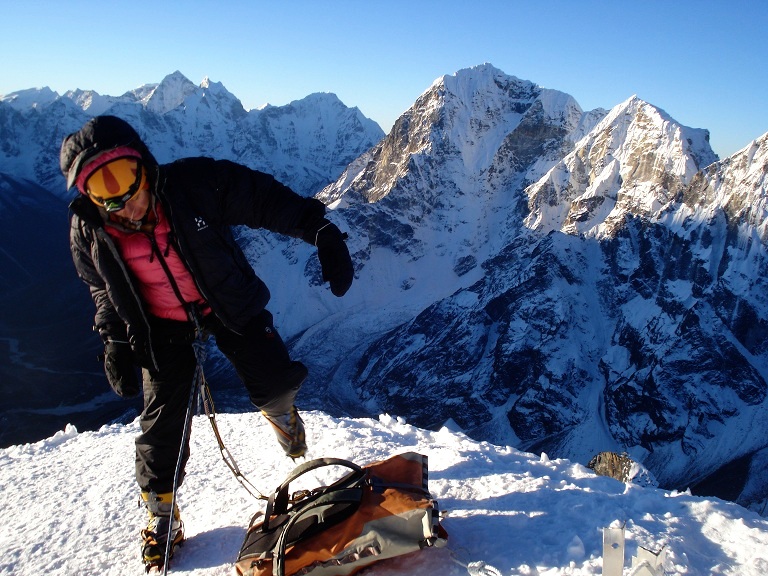
Ridge to the summit. In the background is Ama Dablam


On the summit of Island Peak


Friday, November 4, 2011

Island Peak summit: Success!!!


Second training summit done!

Island Peak (Imja Tse, 6 189m) was more crowded than Lobuche East, and again we're the only ones without any sherpas for the climb. Looks like Island Peak is becoming the Mont Blanc of the Himalajas - it seems to be the first mountain to summit for a lot of people, there are guides staying several months just to bring people up and down, there's a brand new mountain gear shop in Chukkung (closest village) with a good quality equipment etc.

As a route, Island Peak normal is pretty interesting and varied: you have scrambling, exposed ridges, glacier, snowy couloir etc.

Now it's time to relax for a couple of days in the lower villages and then head to our main target, Ama Dablam. The base camp we should reach on around 6th of November.

It's cold (the winter season is definitely approaching), we are tired, but so far everything has gone really well and we're hungry for the main climb to begin.


Raggiunta la seconda vetta di “riscaldamento”!

Island Peak (Imja Tse, 6 189m) era più affollato del Lobuche Est, e ancora una volta eravamo gli unici senza sherpa per la salita. Sembra che Island Peak stia diventando il Monte Bianco dell' Himalaya, sembra che sia la prima montagna scalata per un sacco di gente, ci sono guide che si fermano in zona parecchi mesi solo per portare la gente su e giù, c'è un nuovo negozio di attrezzatura di montagna a Chukkung (paese più vicino) con attrezzatura di buona qualità, ecc

Come percorso l'Island Peak, lungo la via normale, è piuttosto interessante e vario: composto di salite su roccia facile, creste esposte, ghiacciai, neve, couloir innevati. Ecc.

Ora è il momento di rilassarsi per un paio di giorni nei villaggi a quote più basse e poi dirigersi verso il nostro obiettivo principale, Ama Dablam. Dovremmo arrivare al campo base intorno al 6 novembre.

Fa freddo (la stagione invernale è senza dubbio in arrivo), siamo stanchi, ma finora tutto è andato molto bene e siamo impazienti di cominciare la scalata principale.

Monday, October 31, 2011

Photos from Lobuche climb

Settling down in Lobuche base camp


On the way to advanced base camp


On Lobuche summit


Lobuche summit


Looking down from the summit


View from the top


Lobuche summit view. The peak on the left is Pumori (7161mt), and moving to the right there are Everest (8848mt) and  Lhotse (8516mt)


Rappelling on the descent from Lobuche